The No I Nailed to the Studio Wall: A Gallery Rejection That Gave Me Back My Work
The rejection came in a slim white envelope, which felt dramatic until I opened it and realized it was worse: polite. I read it in my car outside the post office while a guy in a Prius waited for my parking spot. The letter said the gallery appreciated my submission, admired the craftsmanship, and regretted that the work was not a fit for their program. I reread the phrase not a fit about six times. Then I drove home, ate a toasted bagel standing up, and told exactly one friend that I was fine.
I was not fine. I had spent three weeks on that proposal. I built the whole thing around a series of paintings about family rooms, the kind with plastic-covered couches and framed photos of people who never sit down. I made a scale model of the show. I wrote an artist statement that sounded like a person who owns a linen blazer. I had already imagined the opening reception. In my imagination, someone in a black turtleneck said the work was brave and then bought me a glass of cheap white wine. Instead, I got a parking lot and a form letter.
The Envelope That Ruined a Tuesday
Here is what nobody tells you about a gallery rejection: it does not feel like a professional decision. It feels like a verdict on your whole personality. For three days, I walked around my studio convinced that every canvas was proof that I had been kidding myself for years. I considered repainting everything. I considered painting nothing. I considered becoming a person with a normal job and a 401(k), someone who does not spend Saturdays sniffing turpentine and questioning her life choices.
Then, on day four, I got mad in a useful way. I printed the rejection letter and put it in a cheap black frame I had bought at a thrift store for four dollars. I did not frame it because I am noble or spiritually advanced. I framed it because I wanted proof. I wanted to look at the no every day and remind myself that I had survived it, that it had not actually killed me, and that the gallery had not been wrong about everything. They were just not the right room.
Why I Hung It by the Wet Paint
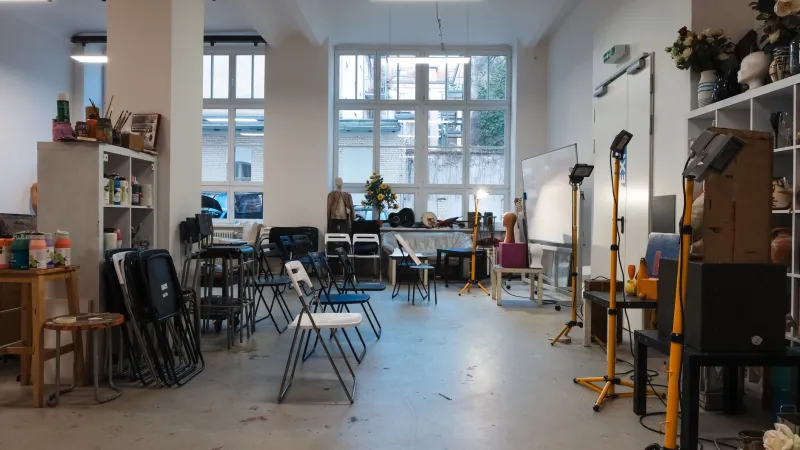
The letter went up on the studio wall between a color chart and a postcard from a museum show I had loved. It is not a trophy. It is a tool. When I start spiraling about whether a piece is good enough for some imagined audience, I look at that letter and remember that good enough is not a universal measurement. It is a relationship. The work can be strong and still be wrong for a specific gallery, a specific curator, a specific season of their program.
A no from a gallery is not a no from art. It is a no from that one hallway. That sounds obvious, but I had been treating every submission like a final exam. I had been letting strangers with nice walls decide whether I was allowed to keep going. And the strangest part is that the gallery never asked for that power. I handed it over myself, along with my proposal and a self-addressed envelope.
The Question Under the Question: Who Was This For?
After the sting wore off, I started asking a better question. Not why did they reject me, but who was I actually making this work for? I had been chasing a certain kind of validation: the white wall, the printed label, the opening where people stand in small groups and say interesting things about the surface tension. That is a real audience, and it is a fine audience. But it was not the only one. It was not even the one I had been imagining when I made the paintings.
I grew up around people who did not go to galleries. They went to work, to church, to the grocery store, to the kitchen table where somebody was always cutting coupons. The paintings I was making were for them. They were for the aunt who keeps every family photo in a shoebox and the cousin who still calls the living room the front room. When I got rejected, I realized I had been trying to translate that work into a language that was not mine just to get through a door. The door was not evil. It was just not my door.
The Best Audience Does Not Always Have the Nicest Walls
A few months later, I showed a smaller version of that same series at a community arts center in a strip mall between a nail salon and a taqueria. The walls were beige. The lighting was fluorescent. The wine was in a box. And it was one of the best shows I have ever had. People stayed for forty minutes. A woman told me the painting of the plastic-covered couch reminded her of her grandmother. A teenager asked how I got the shadows to look wet. Nobody said surface tension.
That show did not pay off my student loans. It did not get me into a fancy art fair. But it reminded me that an audience is not a ladder. It is a conversation. The nicest walls in the world cannot make up for a room that does not need what you are making. And a humble room can give you something a gallery cannot: the feeling that the work is actually doing its job.
What the No Actually Taught Me
I still submit to galleries. I am not anti-white-wall. I am just more careful about why I am doing it. The framed rejection taught me to separate the work from the verdict. It taught me to read a no as information instead of identity. It taught me to ask what a space is for before I ask whether I belong in it. And it taught me that the right audience is not always the one with the best lighting or the most impressive address.
Now when I get a rejection, I let myself be annoyed for a day. I complain to my friend. I eat something with too much butter. Then I print the letter, if it feels worth keeping, and I put it in a drawer. I do not need a wall full of no. I just needed one. One was enough to remind me that a closed door is not a verdict on the house.
The letter is still hanging in my studio. Some days I do not notice it. Some days I look at it and think, Oh right. That was the day I stopped waiting for permission and started making work for the people who were already in the room.