Everything I Never Finished Is Sitting in a Drawer, Judging Me
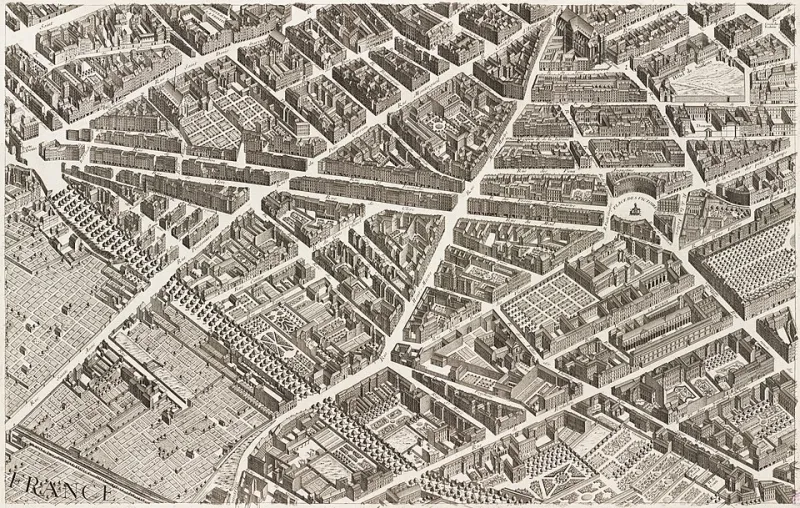
Photo: Louis Bretez / Claude Lucas, Public domain, via Wikimedia Commons
There's a folder on my hard drive called OLD_PROJECTS_DO_NOT_DELETE and inside it lives a graveyard. A young adult novel that stalled at 41,000 words. An illustration series about roadside attractions in the American Southwest that made it to nine pieces before the enthusiasm evaporated somewhere around a particularly difficult rendering of the Cadillac Ranch. A short film I shot with friends in 2019 that I never edited because the footage and the friendship both got complicated.
If you make things, you have a version of this drawer. Maybe it's literal — a box of sketchbooks, a hard drive in a closet in Ohio at your mom's house. Maybe it's a Notes app entry that's just a title and a vibe. Either way, it has weight. Not physical weight. Guilt weight. And guilt, unlike hard drives, does not compress well.
For years I treated my unfinished projects like debts. Every time I opened the folder, I owed an apology. But I've come around to a different way of seeing them, and I want to make the argument here: abandoned work is not failure. It's raw material that hasn't found its form yet. The problem isn't the work. The problem is that we only give ourselves one option — finish it — when there are actually five.
Option One: Revive It (But Only With New Eyes)
Sometimes the project wasn't dead. It was dormant, and what it needed was distance. I've gone back to things after two or three years and found that the person who abandoned them couldn't finish them, but the person I became could. That's the only condition for revival, by the way: you have to be a different artist than the one who quit. Going back as the same person, with the same block, is just reopening the wound on a schedule. If you return, return changed — new skills, new perspective, new reason.
Option Two: Cannibalize It
This is my favorite and the one nobody talks about. That stalled novel? Chapter seven has a monologue I've used, reworked, in a short story and a stage reading. The roadside attractions series? Three of the nine illustrations became prints that actually sell, and the texture technique I developed on piece number six — the Cadillac Ranch disaster — is now the backbone of my whole current style.
Unfinished projects are organ donors. The whole doesn't survive, but the parts can save dozens of other works. Stop asking 'how do I finish this?' and start asking 'what in here is worth stealing?' You're allowed to rob your own grave.
Option Three: Exhibit It As-Is
There's a growing appetite for the unfinished, and I think it's partly a reaction against the polished-to-death content that floods every feed. I once showed the nine roadside attraction pieces at a small group show with a wall label that read, honestly, 'Series abandoned, 2017 — nine of a planned twenty.' People spent more time with those than with the finished pieces. The incompleteness gave them room. Viewers projected into the gap where the other eleven were supposed to be.
You can do this at any scale: a blog post of unpolished work, a zine of fragments, an Instagram carousel titled 'things I didn't finish.' Framing matters. You're not showing failure; you're showing process, and process is honest in a way finished work rarely is.
Option Four: Archive It With Ceremony
Some projects deserve a respectful burial rather than a slow rot. I did this with the short film. I backed up the footage properly, labeled it, wrote a one-page document about what it was and why it stopped — the honest version, including the friendship part — and then I let it go. The ceremony matters. An intentional ending closes the loop that guilt keeps prying open. You're not deleting it; you're filing it in your history. A finished chapter, just not the chapter you planned.
Option Five: Kill It on Purpose
And sometimes — this is the heretical one — the right move is to consciously, deliberately decide it's dead, and mean it. Not 'someday.' Not 'when I have time.' Dead. Say it out loud. Delete the files if you're the type, or archive them under a name that doesn't scream at you.
Here's why this works: unfinished projects don't just take up storage. They take up psychic bandwidth. Every abandoned project is a small open browser tab in your brain, quietly draining attention. Killing one on purpose closes the tab. And in my experience, the energy that gets freed up is immediately available for the work you're actually meant to do. The novel I finally declared dead was followed, within four months, by the most productive creative period of my life.
The Drawer Doesn't Have to Weigh Anything
I still have the OLD_PROJECTS_DO_NOT_DELETE folder. But I renamed the files inside it last month. The novel is now 'organ donor #1.' The film is 'archived with love, 2019.' The attractions series is 'partially harvested, prints available.'
Same files. Same work. Completely different relationship to it. The guilt pile became a supply closet.
Your unfinished projects were never a verdict on you. They were attempts — real, costly, brave attempts — and attempts leave material behind. Revive it, harvest it, show it, bury it, or kill it. Just stop letting it sit there, unsorted, collecting interest in guilt.
The drawer is only heavy if you never open it.