Thirty Days of Painting Like a Five-Year-Old: My Unscheduled Making Experiment
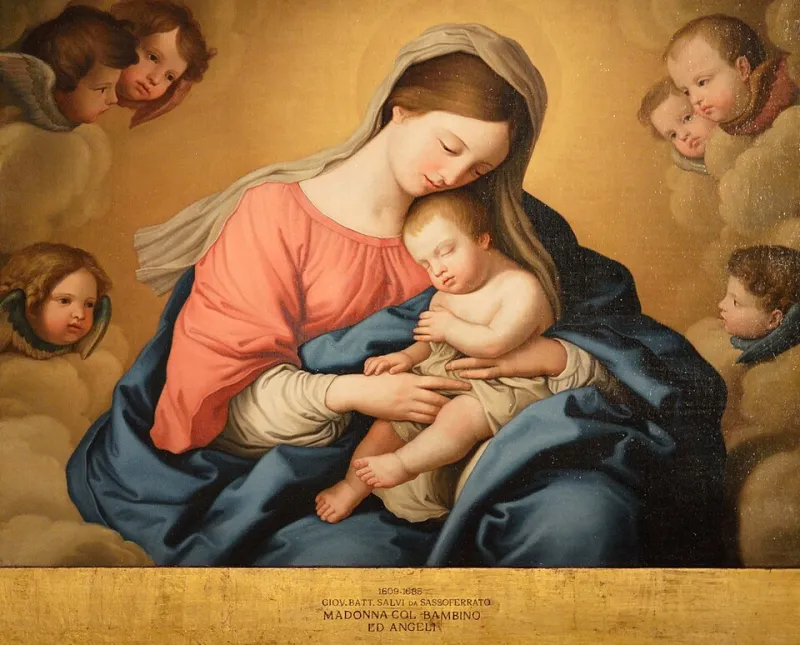
Photo: Giovanni Battista Salvi da Sassoferrato, Public domain, via Wikimedia Commons
The five-year-old in the second row did not care about my calendar.
I'd volunteered to help at a Saturday art class at the community center near my apartment—something my neighbor guilted me into, one of those "we're short on adults" texts you say yes to before your brain catches up. My job was simple: hand out paper, unclog glue sticks, keep paint off the ceiling. What I didn't expect was to stand there holding a brush and feel personally attacked.
One kid spent forty minutes on a single purple blob. Forty. Minutes. Nobody told her it was taking too long. Nobody asked what the ROI on the blob was. When she finished, she held it up, said "it's a dog," and moved on to finger paint like a woman who had nothing left to prove.
Meanwhile, I'd spent that same morning rescheduling a client call twice, blocking out my afternoon in 25-minute increments, and feeling vaguely sick because I hadn't opened my sketchbook in three weeks. Three weeks. The sketchbook was sitting right there in my bag, like a parrot nobody feeds.
The Tyranny of the Time Block
Here's the thing about how most of us working creatives run our days: we inherited a system built for people who bill by the hour. Time blocking, deep work sprints, the Pomodoro thing—these are all tools for squeezing maximum output out of minimum minutes. They're great when your work is predictable. They're less great when your work is, you know, ideas.
My calendar looked like a war room. Client work in green, admin in yellow, and—this is the embarrassing part—a literal block labeled "PERSONAL PROJECTS (DO NOT SKIP)" that I skipped. Consistently. For months. Because a two-hour window on a Thursday doesn't summon inspiration. It just sits there, ticking, turning making things into another deadline.
Watching those kids paint, I realized they had no concept of a session ending. They stopped when the painting was done or when snack happened. That's it. That was the whole methodology.
So I ran an experiment. Thirty days of what I started calling "unscheduled making." No calendar blocks for creative work. No timers. The only rule: make something small every day, whenever the mood actually showed up, for as long as it wanted to stay.
What Got Better
The quantity surprised me. I made more in thirty loose days than in the previous three months of rigorously scheduled ones. Part of it was that making stopped feeling like a chore with a start time. I'd do fifteen minutes with coffee before a client call. Twenty minutes while pasta water boiled. Once, a full hour at 10 p.m. because an idea showed up uninvited and I let it in.
The work was better, too. Looser. When you're not watching the clock, you take weirder turns. You paint the purple blob for forty minutes because the purple blob deserves it.
And honestly? My anxiety dropped. Not to zero—let's be real—but the low-grade hum of "you should be making something right now" quieted down. Turns out a block on a calendar you keep ignoring generates more guilt than no plan at all.
What Got Worse
I'm not going to pretend this was a miracle cure, because it wasn't.
Client work suffered at the margins. Deadlines that used to get handled in tidy afternoon blocks started bleeding into evenings. One invoice went out four days late. If your business runs on tight turnaround and you drop structure entirely, things wobble. Kids can paint until snack time because somebody else handles the snack logistics. Adults with invoices? We're the snack logistics.
Also, some days the mood never showed up. Unscheduled making requires a certain baseline of self-trust, and on the days I was tired or cranky, "whenever inspiration strikes" became "never." A few days I had to basically trick myself into the studio with the excuse of tidying up.
What I Actually Kept
After the thirty days, I landed somewhere in the middle—a hybrid that fits how I actually work:
- Client work stays scheduled. Hard blocks, tight windows, treated like the job it is.
- Personal work stays unscheduled, but with a daily floor: ten minutes minimum, any time, no agenda.
- One weekend session a month where I paint like the kindergartner—no outcome, no posting it, no purpose. The purple blob protocol.
The biggest shift wasn't logistical, though. It was the realization that productivity culture sold me a schedule built for output, and then I blamed myself when creative input wouldn't cooperate. Kids don't schedule wonder. They just leave the door open for it.
The five-year-old with the purple dog doesn't know she taught me anything. She's probably moved on to crayons by now. But I think about her every time I feel that 2 p.m. panic about an unproductive hour. The blob took forty minutes. The blob was worth it.